Choosing a scroll air compressor in 2026 requires more than comparing horsepower and purchase prices. The correct choice begins with the application. A dental clinic, electronics room, and automotive workshop need different air quality, pressure, and operating patterns. Small details matter. A forgotten leak can quietly increase energy costs.
Compressed-air specialist Hank van Ormer is widely associated with the practical statement, “Compressed air is the fourth utility.” That reminder should guide every selection decision. A scroll air compressor may suit facilities needing quiet, oil-free air and stable operation. However, suitability depends on measured demand, not marketing language. Check the required flow in cubic feet per minute, working pressure, duty cycle, and air-quality class. Confirm whether the receiver tank can handle peak demand without excessive cycling.
Look closely at the installation area. Imagine the compressor beside a consultation room or a clean production line. Noise, heat, ventilation, and access for maintenance become real operating concerns. Compare fixed-speed and variable-speed models carefully. Variable-speed control can reduce waste during changing demand, but it may add cost and electronic complexity. Ask for verified performance data under your actual conditions. Manufacturer brochures are useful, but they are not independent tests.
Experience also teaches humility. I have seen buyers focus on efficiency ratings while ignoring poor pipe sizing. That mistake is expensive. A complete evaluation should include lifecycle energy, filters, dryers, service intervals, spare parts, and expected downtime. The cheapest model may not be the most reliable. Measure twice. Then choose a scroll air compressor that matches today’s workload and tomorrow’s realistic expansion.
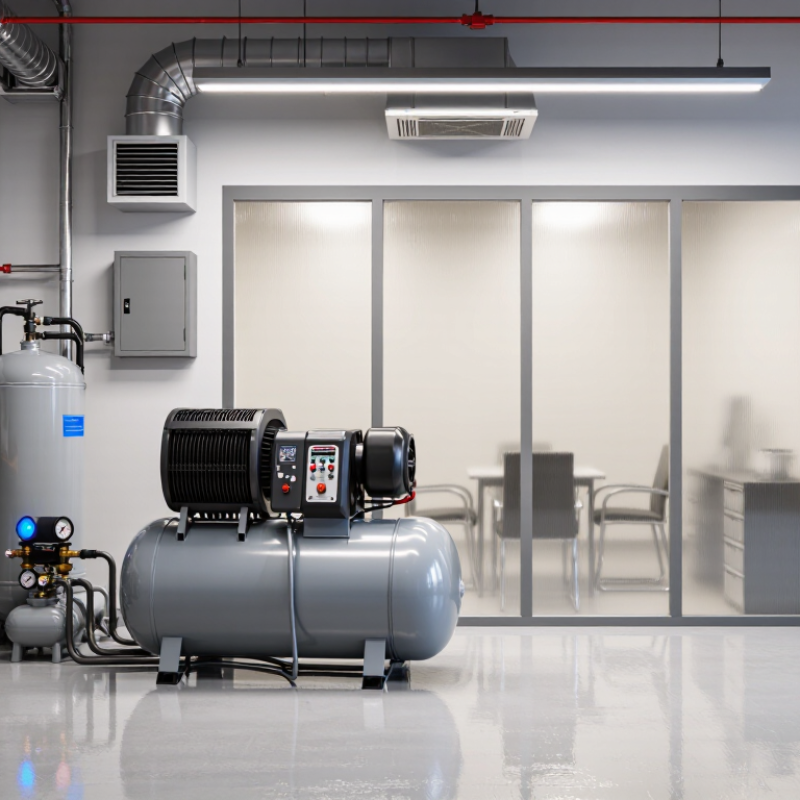
Choosing a scroll air compressor starts with measuring air demand, not browsing catalogues. Record required flow in m³/min or CFM during normal and peak production. List every tool, actuator, nozzle, and cleaning point using compressed air. A small leak can distort the calculation. It happens often. Measure pressure at the farthest use point, not only at the compressor outlet. Confirm working pressure and acceptable pressure loss through dryers, filters, and piping.
Operating conditions also shape the selection. Note daily running hours, duty cycle, ambient temperature, altitude, ventilation, and available electrical supply. A warm, dusty room may reduce cooling performance and shorten service intervals. Check whether the application needs oil-free air, especially around food, pharmaceutical, laboratory, or sensitive electronic processes. Define the required air quality using an appropriate classification, such as ISO 8573-1. Moisture control matters too. Specify the pressure dew point required at the point of use.
It is tempting to size the compressor from average consumption. That approach can fail when several machines start together. A demand profile from a data logger is more reliable than memory or a rough estimate. If measurements are incomplete, document the uncertainty and allow a controlled margin rather than excessive capacity. Oversizing may increase purchase and energy costs, while undersizing can cause pressure drops and frequent cycling. Leave room for future equipment, but question every assumed expansion.
Define Your Compressed-Air Requirements and Operating Conditions
Choosing a scroll compressor starts with its configuration, not its catalog size. Oil-free models suit medical air, laboratories, and sensitive packaging lines. Lubricated models can reduce purchase cost and tolerate harsher workshop conditions. A fixed-speed unit may fit steady demand. Variable-speed control performs better when production changes hourly. The wrong match creates frequent cycling, unstable pressure, and unnecessary heat.
Core technology matters at the operating point. An orbiting scroll compresses air with fewer rubbing parts than many piston designs. This can reduce vibration and maintenance. However, scroll elements still need correct cooling, filtration, and inlet conditions. Air-cooled systems simplify installation. Water-cooled systems may manage heat better, but they add pumps, treatment, and inspection needs. Redundancy also matters: two smaller modules can maintain production during service , although their controls must share load accurately.
The U.S. Department of Energy’s Improving Compressed Air System Performance sourcebook reports that leaks can waste 20–30% of compressor output. That figure changes the buying decision. A larger compressor may hide leakage rather than solve it. Check pressure demand at the farthest point, duty cycles, dew point, and future expansion.
ISO 8573-1 should guide air-quality specifications, while AHRI Standard 540 supports compressor performance measurement. I would still question every efficiency claim without test conditions. A promising number at full load may disappoint at half load. Feel the discharge temperature, listen for cycling, and review service access before signing.
How to Choose a Scroll Air Compressor in 2026?
Capacity should match measured demand, not a hopeful production forecast. Record flow during shifts, start-ups, and cleaning cycles. A 7-bar line may briefly fall below 6 bar when several tools operate together. That pressure drop can signal undersized piping, poor storage, or an overloaded compressor. The U.S. Department of Energy reports that compressed air can consume about 10% of industrial electricity. Its Compressed Air Sourcebook also estimates that leaks may waste 20–30% of compressor output. Therefore, check actual leakage before purchasing extra capacity. Bigger is not automatically safer.
Efficiency requires more than comparing motor ratings. Review specific power, unloaded running time, control response, service intervals, and performance at partial load. A compressor that looks efficient at full capacity may waste energy during quiet hours. I have seen clean installations lose efficiency through wet filters and neglected drains. That detail is easy to miss. Air quality deserves equal attention. ISO 8573-1 classifies particles, water, and oil separately, so choose the required class for each application. Instrument air, packaging, and general workshop tools may need different treatment. The European Commission’s Best Available Techniques reference documents emphasize leak reduction, pressure management, and system monitoring as practical energy measures. Use those principles, but verify them with site measurements. A neat spreadsheet can still mislead. Check flow meters, dew point readings, and pressure logs before approving the final specification.
How to Choose a Scroll Air Compressor in 2026?
A scroll air compressor should fit the site before it fits the budget. Start with installation conditions. Measure available floor space, door width, ceiling height, and ventilation paths. Leave clear access around the unit for inspections and component replacement. Check voltage, frequency, pipe size, and expected operating pressure. A receiver tank can reduce frequent starts, but it also needs suitable drainage and safe placement. Small details matter. For sensitive applications, define the required air purity class under ISO 8573-1.
Maintenance begins with realistic access. Ask whether technicians can reach filters, drains, cooling fans, and electrical panels without moving nearby equipment. Confirm the recommended inspection intervals and expected life of scroll tip seals. Keep service records with operating hours, pressure readings, and fault codes. These details often expose gradual performance loss. I have seen compressors blamed for poor output when blocked filters caused the real problem. A spreadsheet cannot reveal every site habit.
Reliability depends on matching capacity to demand. Review duty cycles, peak loads, ambient temperature, and the cost of downtime. For critical air systems, consider two smaller units instead of one large machine. Service support deserves equal attention. Request local technician coverage, spare-parts availability, commissioning help, and clear response times. Ask for practical training, not only a digital manual. Call procedures should be simple. An attractive warranty means little if parts remain unavailable for weeks. Some selection decisions still require careful review after installation.
| Assessment Area | Selection Dimension | Practical Data or Benchmark | Recommended Evaluation | Priority |
|---|---|---|---|---|
| Installation Needs | Required air flow | Determine the actual demand in m³/min or CFM, including peak demand, average demand, and future expansion. Avoid sizing only from connected equipment nameplates. | Select a compressor package that covers peak demand without excessive unloaded or standby operation. Confirm performance at the required discharge pressure and site temperature. | Critical |
| Installation Needs | Operating pressure | Common plant-air systems operate around 7–10 bar(g), but the correct value depends on the end-use equipment and pressure losses in the distribution system. | Use the lowest pressure that satisfies the application. Every unnecessary increase in discharge pressure generally increases energy consumption. | Critical |
| Installation Needs | Air quality | Oil-free scroll technology can be suitable for applications requiring clean compressed air. The required ISO 8573-1 air-quality class should be confirmed with the process owner. | Define limits for particles, water, and oil before purchase. Add dryers, filters, drains, or receivers where the application requires them. | Critical |
| Installation Needs | Available space and access | Scroll compressors are generally compact, but the installation still requires clearance for ventilation, electrical access, inspection, and component replacement. | Check the complete layout drawing, service-side clearance, lifting route, floor loading, and noise-sensitive areas before ordering. | High |
| Installation Needs | Electrical supply | Verify voltage, phase, frequency, starting current, protection requirements, and available power capacity. Multi-module systems may distribute electrical load across several motors. | Obtain electrical data for the complete package, including dryer, controls, fans, and auxiliary equipment. | Critical |
| Maintenance | Routine service requirements | Typical tasks include checking inlet filters, ventilation paths, condensate management, electrical connections, operating temperatures, and alarm history. | Request a maintenance schedule based on operating hours and site conditions. Dusty, hot, or humid environments usually require more frequent inspection. | High |
| Maintenance | Wear-part replacement | Scroll tip seals, inlet filters, valves, sensors, belts where fitted, and motor-related components may require replacement during the equipment life cycle. | Compare replacement intervals, parts prices, labor time, and the availability of service kits rather than comparing purchase price alone. | High |
| Reliability | Duty cycle and redundancy | For continuous or critical-duty applications, multiple smaller scroll modules can provide capacity staging and partial redundancy if the control system is designed for it. | Assess whether the process can continue if one module is unavailable. Define the required backup capacity and acceptable downtime. | Critical |
| Reliability | Ambient conditions | High ambient temperature, airborne dust, corrosive gases, poor ventilation, and high humidity can reduce performance and shorten component life. | Confirm the specified operating envelope and derating data. Provide suitable room ventilation, filtration, and environmental protection. | Critical |
| Reliability | Controls and monitoring | Useful functions include pressure control, sequencing, fault alarms, operating-hour tracking, remote communication, and trend monitoring. | Verify compatibility with the plant control system and confirm which data interfaces are included as standard. | High |
| Service Support | Local technical response | Response time should be defined for routine service, emergency breakdowns, troubleshooting, and commissioning support. | Obtain written service coverage, escalation contacts, technician availability, and expected response times for the installation location. | Critical |
| Service Support | Spare-parts availability | Lead times for filters, seals, sensors, valves, motors, controllers, and complete service kits can directly affect production continuity. | Ask for standard parts lead times, recommended on-site inventory, part obsolescence policy, and supply support after the warranty period. | Critical |
| Service Support | Documentation and training | A complete package should include installation instructions, operation manuals, wiring diagrams, maintenance procedures, alarm definitions, and safety information. | Prefer suppliers that provide digital documentation, operator training, commissioning records, and clear warranty conditions. | High |
| Total Cost | Life-cycle cost | Evaluate purchase price, electricity, dryers and filters, preventive maintenance, spare parts, service labor, downtime risk, and end-of-life disposal. | Use a multi-year total-cost-of-ownership model based on measured air demand, annual operating hours, electricity price, and expected service intervals. | Critical |
Calculate Total Ownership Cost and Select the Right 2026 Model
Choosing a scroll air compressor in 2026 should begin with air demand, not purchase price. Record pressure, flow, operating hours, and seasonal production changes. A unit that runs constantly may need more capacity or variable-speed control. Oversizing also wastes money. It can create inefficient cycling and higher service costs.
Calculate total ownership cost using purchase, installation, electricity, maintenance, filters, downtime, and disposal expenses. Ask suppliers for tested efficiency data at your actual pressure. Then compare projected annual energy use. A simple spreadsheet helps. Include electricity tariffs, demand charges, and expected operating hours. Small errors matter. A one-percent efficiency difference can become significant over several years.
Check the compressor’s footprint, sound level, controller, and service access. Oil-free operation may suit laboratories, food production, or sensitive manufacturing, but verify the required air-quality class. Review maintenance intervals and spare-part availability before signing an order. Digital monitoring can reveal leaks, rising temperatures, or abnormal cycling early. Do not trust every calculator. Real factory conditions often differ from brochures. Recheck assumptions with measured plant data, an electrician, and a qualified compressed-air technician. The best 2026 model is not the newest one. It is the model that delivers stable air at the lowest credible ownership cost.