(770) 529-4731
esen

Why Choose a Spindle Hub Bearing Assembly?

Choosing the right wheel-end component affects safety, maintenance cost, and driving confidence. A Spindle Hub Bearing Assembly combines the bearing, hub, and related mounting features into one engineered unit. This design can simplify replacement and reduce alignment errors during service. However, convenience alone should not decide the purchase.

SKF’s Bearing Damage and Failure Analysis guidance identifies lubrication, contamination, mounting, and operating conditions as major contributors to bearing problems. Its practical message is clear: correct installation matters as much as product quality. Timken’s engineering resources also emphasize proper fits, preload, sealing, and torque control. These details become visible in real workshops. A mechanic may find rust near the flange, a damaged ABS sensor wire, or uneven tire wear beside a noisy hub. Each clue deserves attention.

Market research from Grand View Research reports continuing demand for automotive wheel bearings as vehicle fleets expand and replacement needs rise. Yet market growth does not guarantee equal quality. Some assemblies appear identical in a catalog but differ in steel grade, seal design, sensor compatibility, and machining accuracy. That difference can become a vibration at 60 miles per hour. Or an avoidable comeback repair.

A reliable selection process should compare OE specifications, load ratings, warranty terms, and traceable testing data. Installation should follow the vehicle maker’s torque procedure, not guesswork. ISO 15243 can also support consistent failure analysis after removal. The decision is not perfect every time. Still, careful evidence makes the choice far more defensible.
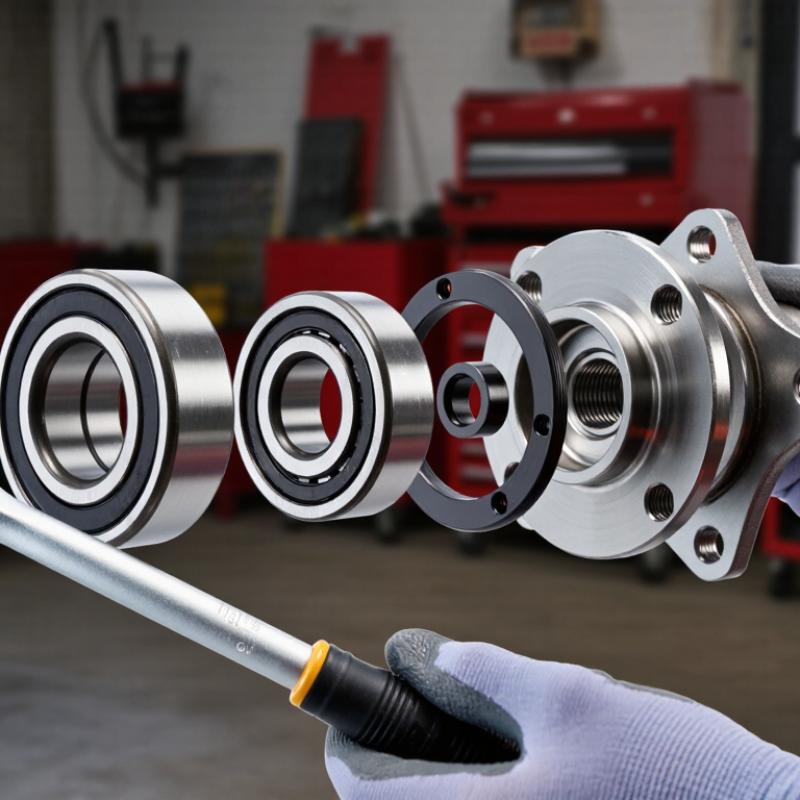
Why Choose a Spindle Hub Bearing Assembly?

What Is a Spindle Hub Bearing Assembly? Components and Core Functions

Why Choose a Spindle Hub Bearing Assembly?

What Is a Spindle Hub Bearing Assembly? Components and Core Functions

A spindle hub bearing assembly is a prearranged unit connecting a vehicle wheel to its steering and suspension system. It usually includes the hub, bearings, seals, mounting flange, and wheel studs. Some designs also contain an integrated speed sensor. The hub supports the wheel and transfers driving, braking, and cornering loads. The bearings allow smooth rotation around the spindle. Simple in purpose.

In workshop practice, the assembly must manage radial loads, axial loads, heat, vibration, and road contamination. Seals help retain grease while blocking water and grit. The flange provides a stable mounting surface for the wheel and brake components. A sensor, when fitted, reports wheel speed for braking and stability systems. Correct preload matters greatly. Too much can create heat; too little may cause play and uneven wear.

Choosing a complete assembly can reduce installation errors and save service time. It also replaces several worn parts with matched components. However, replacement is not automatically better. Technicians should check fitment, torque specifications, mating surfaces, and sensor connections. A quiet test drive is not enough evidence. Measure play, listen for growling, and inspect tire wear. I have seen small installation mistakes become expensive repairs. The honest lesson is that a bearing can look sound and still fail under load.


How ISO 281’s 90% L10 Rating Measures Bearing Service Life

Why Choose a Spindle Hub Bearing Assembly?

ISO 281 gives engineers a consistent way to estimate bearing fatigue life. Its L10 rating represents the point when 90% of identical bearings are expected to survive. The remaining 10% may develop fatigue earlier. This is a statistical measure, not a promise for every assembly.

The calculation uses the bearing’s dynamic load rating and equivalent operating load. It also considers the life exponent for the bearing type. For a spindle hub assembly, small changes in radial load can greatly affect calculated life. A heavier cutting load, belt tension, or wheel impact may shorten service life sharply. The result is usually expressed in millions of revolutions, not calendar years.

Real installations are less controlled than laboratory assumptions. Contamination, poor lubrication, misalignment, excessive preload, and incorrect mounting can reduce actual life. In maintenance inspections, uneven raceway marks often reveal load or alignment problems before failure becomes obvious. Temperature readings and vibration trends can add useful evidence. Still, these checks require careful interpretation. ISO 281 does not fully predict damage from handling errors, electrical currents, or severe shock loads. That limitation matters. A spindle hub bearing assembly should therefore be selected with measured loads, operating speed, sealing needs, and installation quality in mind. Reliability improves when the calculation is treated as a technical baseline, not the entire service-life story.

Why Choose a Spindle Hub Bearing Assembly? - How ISO 281’s 90% L10 Rating Measures Bearing Service Life

Evaluation Dimension ISO 281 / Engineering Basis Illustrative Data or Formula Why It Matters for a Spindle Hub Bearing Assembly
Rated reliability The standard basic rating life, L10, is defined at 90% reliability under stated operating conditions. L10 = 90% reliability; statistically, 10% of an identical bearing population may not reach this life. Provides a consistent reference for comparing bearing service life without presenting the value as a guaranteed replacement interval.
Basic dynamic load rating C is the constant load that a group of apparently identical rolling bearings can carry for a basic rating life of 1 million revolutions. C = 30 kN, used only as an example for the calculation below. A higher load rating generally improves calculated fatigue life when load, lubrication, alignment, and contamination are controlled.
Equivalent dynamic bearing load P represents the constant radial load that would produce the same effect as the combined radial and axial loading. P = 5 kN, used as an example operating load. Correctly estimating hub loads is essential because bearing life is highly sensitive to the ratio of C to P.
Life equation for ball bearings For ball bearings, the ISO 281 basic rating life is calculated with exponent p = 3. L10 = (C/P)3 × 106 revolutions. The cubic relationship means a moderate reduction in bearing load can produce a substantial increase in calculated fatigue life.
Illustrative calculated life Using the example values C = 30 kN and P = 5 kN: L10 = (30/5)3 × 106 = 216 × 106 revolutions. This is a calculated fatigue-life reference, not a prediction that every assembly will operate for the same duration.
Life in operating hours L10h converts revolutions into hours using the rotational speed n. L10h = L10 ÷ (60n). At n = 1,800 r/min: 216,000,000 ÷ 108,000 = 2,000 hours. Allows designers to compare bearing life with duty cycles, maintenance intervals, and expected spindle or wheel operating time.
Combined radial and axial loading Equivalent load may be expressed using bearing-specific factors, commonly in the form P = X Fr + Y Fa, where applicable. Fr = radial load; Fa = axial load; X and Y depend on bearing design and loading conditions. A preassembled hub unit can simplify the design of load paths and help maintain the intended bearing arrangement under combined loads.
Speed and temperature Rotational speed affects operating-hour conversion, while temperature can influence lubricant performance, clearance, and material behavior. Higher speed reduces hours per revolution-based life; operating temperature must remain within the bearing and lubricant design limits. A spindle hub assembly should be selected for its actual speed, thermal environment, and duty cycle rather than load rating alone.
Contamination and sealing The basic L10 calculation does not fully represent damage caused by dirt, water, inadequate sealing, or poor lubrication. Clean lubricant, suitable seals, and controlled assembly conditions are required for the calculated life to be meaningful. An integrated hub bearing assembly can reduce exposure to handling errors and help protect internal rolling contacts when properly specified.
Installation and alignment Misalignment, incorrect fits, excessive preload, insufficient preload, and mounting damage can reduce practical service life below the calculated rating life. Use controlled fits, correct torque, clean tools, and alignment checks during installation. A preassembled unit can reduce the number of assembly steps and support more repeatable installation when the surrounding components are correctly designed.
Interpretation of service life ISO 281 basic rating life describes rolling-contact fatigue life under defined conditions; it does not cover every possible failure mode. Actual service life can be limited by wear, corrosion, electrical damage, seal failure, excessive heat, brinelling, or installation defects. Use L10 as one part of a complete selection process that includes reliability, maintenance, environment, stiffness, and safety requirements.
Note: The numerical values in the calculation rows are illustrative engineering inputs, not product specifications. Actual bearing life should be calculated from the selected bearing’s verified load rating, applied loads, speed, lubrication, temperature, sealing, and installation conditions.

Why Preload and Rigidity Control Spindle Runout and Vibration

Why Choose a Spindle Hub Bearing Assembly?

A spindle hub bearing assembly can improve alignment, stiffness, and installation consistency. Its value becomes clearer when preload is set correctly. Preload removes internal clearance between the rolling elements and raceways. This helps the spindle resist small deflections during cutting. Less movement usually means lower radial runout and steadier surface quality.

Rigidity matters most when cutting forces change quickly. A rigid bearing support limits shaft displacement and reduces vibration caused by interrupted loads. However, excessive preload creates friction, heat, and unwanted expansion. That can increase runout after the spindle warms up. Not ideal.

During practical inspection, technicians often measure runout with a precision indicator before and after warm-up. A cold spindle may appear accurate, then shift several microns at operating temperature. Checking endplay, mounting fits, clamping torque, and bearing seating can reveal the cause. The hub assembly also helps keep these interfaces controlled, but it cannot correct a bent shaft or poor housing geometry.

Vibration has several sources. Bearing waviness, imbalance, tool projection, and resonance may all contribute. Preload only addresses part of the problem. This is where judgment matters. A tighter setting is not automatically better. Engineers should match preload and rigidity to speed, load, temperature, and required finish. In real production, one overlooked thermal effect can weaken an otherwise careful design.

How Sealing and Lubrication Manage Heat at High DN Speeds

Why Choose a Spindle Hub Bearing Assembly?

At high DN speeds, heat becomes a design problem, not a minor detail. DN combines bearing bore diameter and rotational speed. As either value rises, friction can increase quickly. A spindle hub bearing assembly helps keep the rotating group compact, aligned, and easier to control.

Sealing and lubrication work together inside this narrow operating space. A properly designed seal limits dust and moisture entry while retaining grease near the rolling contacts. However, a seal also creates friction. Excessive contact pressure may raise temperature, especially during continuous operation. Non-contact gaps can reduce drag, but they demand better protection from contamination. There is no universal seal choice.

Lubricant selection matters just as much. Low-viscosity grease can reduce churning at high speed, while sufficient film strength protects the raceways. Too much grease may whip, causing heat near the cage and seal. Too little may leave metal surfaces vulnerable. Small changes matter. In practical testing, engineers often monitor housing temperature, vibration, and running torque after stabilization. A temperature rise that looks acceptable at startup may become serious after several hours. This is easy to miss.

Correct preload, shaft fit, and alignment also influence heat flow. A clean assembly area helps, but cleanliness alone cannot repair poor adjustment. One overlooked issue is lubricant migration during storage or transport. The bearing may appear ready, yet its grease distribution can be uneven. Careful installation records and periodic inspection make the performance more dependable, although the process is never entirely perfect.

When Integrated Assemblies Reduce Installation Errors and Maintenance Time

Why Choose a Spindle Hub Bearing Assembly?

When Integrated Assemblies Reduce Installation Errors and Maintenance Time

A spindle hub bearing assembly combines bearings, seals, and mounting features in one controlled unit. This design reduces handling during installation. Technicians avoid pressing separate rings, setting preload, and aligning multiple components at the machine.

That matters beside a busy production line. A single misplaced spacer can create noise, heat, or premature wear. Integrated assemblies usually arrive pre-adjusted and sealed. They can shorten fitting time and reduce contamination risks. The U.S. Department of Energy’s Operations & Maintenance Best Practices Guide reports 8–12% savings from predictive maintenance, compared with routine preventive maintenance. Fewer installation variables support that approach.

The maintenance benefit appears during inspection. Technicians can replace one assembly instead of rebuilding a bearing stack. Downtime becomes easier to estimate. The same DOE guide reports potential savings of 30–40% when predictive maintenance replaces reactive maintenance. These figures do not guarantee results. Application data still matters.

A practical check is essential. Confirm shaft dimensions, load direction, speed, sealing conditions, and sensor requirements before ordering. A compact assembly may simplify service, but it can also hide a wrong specification. That weakness deserves attention. In field work, removing one part is not enough; the replacement must match the spindle’s thermal and operating behavior.

Why Choose a Spindle Hub Bearing Assembly?

Integrated assemblies can reduce installation errors and maintenance time by combining matched components into one service-ready unit.

The comparison uses representative service-workflow values: integrated assemblies require fewer installation steps, create fewer potential error points, and shorten routine maintenance time.